


Welcome to The Mexpatriate.
In today’s edition, I take a look at the labor law reform currently under discussion in Congress that will (eventually) bring the 48-hour work week down to 40 hours in Mexico—and why some say it’s a wolf in sheep’s clothing.
If you have feedback or questions, please email me at hola@themexpatriate.com or leave a comment below. I’ll be back in your inbox on Friday with an arts + culture edition of The Mexpat Dispatch.

“There must be something wrong with work, or the rich would have a monopoly on it.”
—Mario Moreno “Cantinflas”
One of the headline items on the legislative agenda since Congress returned to session on Feb. 1 is the long-anticipated 40-hour work week reform.
The draft bill President Claudia Sheinbaum sent to the Senate this week is the product of meetings the Department of Labor organized last year with the business sector, as well as labor unions and NGOs, and according to Secretary of Labor Morath Bolaños, it will most benefit workers in manufacturing, retail, hospitality and transportation.
However, some lawmakers and labor activists who have been advocating for this reform for years claim it has been hollowed out to favor employers’ interests. The legislation maintains the six-day work week, instead of cutting to five days as in earlier proposals, and allows a maximum of 12 overtime hours per week at double pay (an increase from nine under current law).
Jorge Álvarez Máynez, the president of Movimento Ciudadano (MC) and 2024 presidential candidate, called the bill a “bait and switch,” warning that it could even be regressive for labor rights.
“This one difference [maintaining the six-day week] makes it necessary to open a broad, transparent debate…what is at stake here is very significant in the daily lives of workers,” said Federal Deputy Patricia Mercado (MC) to Congress on Monday. “This is an opportunity to vindicate the most authentic spirit of social justice of the 1917 Constitution.”
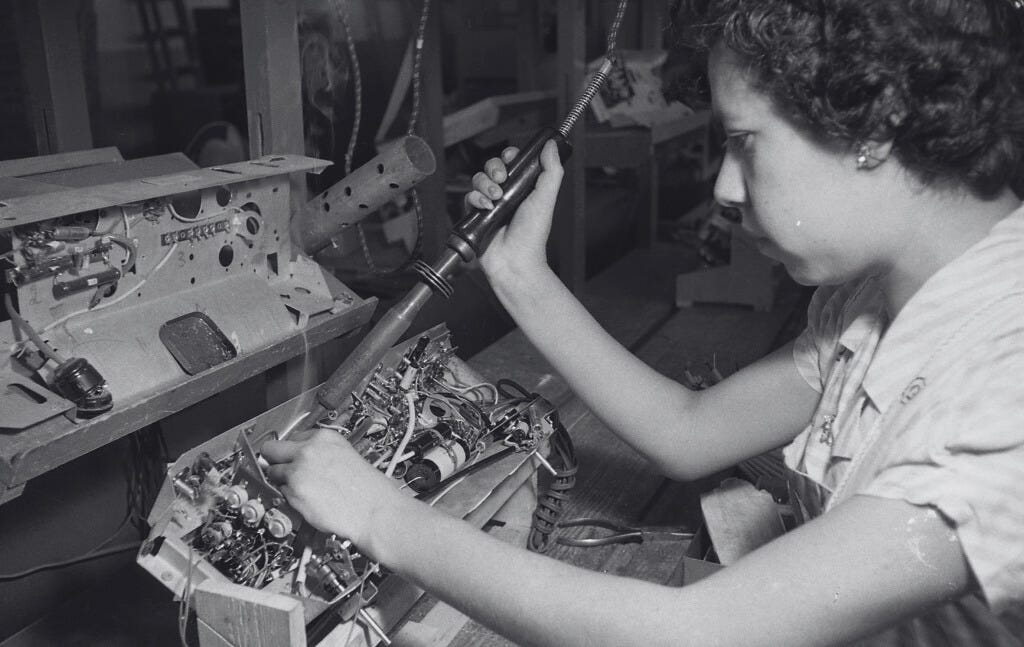
Work smarter, not longer
Mexico’s Federal Labor Law was first enacted in 1931, the same year the country joined the International Labour Organization (ILO), which would establish the norm—though not globally adhered to—of a 40-hour work week. Ninety-five years later, the official work week in Mexico is still 48 hours (with only one mandatory day off) and Mexicans work more hours than anyone else in the 38 member countries of the OECD (13.4 million work 48 hours or more per week).
Why is this the case?
The answer is the same in many developing economies: low wages, lack of capital investment and a large informal economy. Mexican workers make up for low pay with volume of hours, and many are employed in industries that are labor-intensive (manufacturing, agriculture) or are precariously self-employed.
Mexico’s workforce ranks last in productivity in the OECD, though this should come as no surprise since economists calculate this using output (real GDP) as the numerator and hours worked as the denominator. In Latin America, however, Mexico is less of an outlier. In Brazil—the largest economy in the region—GDP output per hour is roughly US $17, while it is about US $20 in Mexico. And most other countries in Latin America also have a long work week; last year, Chile started a gradual reduction from 45 to 40 hours by 2028, and Colombia has reduced by one hour a year since 2023, to reach 42 this year. In this context, Sheinbaum’s plan to shave eight hours off the work week by 2030 (two hours per year starting in 2027) looks ambitious.
The slow path to reform
The reduction to a 40-hour work week has been on the ruling party’s agenda since López Obrador’s term—but repeatedly postponed. In 2022, a proposal was first introduced in Congress and the bill advanced in 2023, but then stalled. Sheinbaum made this reform one of her term’s 100 commitments when she took office in 2024.
Why has the ruling party, in all its reforming zeal, failed to deliver on this one?
“The reason is fear,” wrote analyst Viri Ríos, back in January 2025. “Doing it [reforming the law] would be a labor earthquake greater than raising the minimum wage…The fear is that businesses won’t be able to sustain it, but this concern is unfounded.” Ríos argues that since Mexico is far below the global average when it comes to the labor share of income as percentage of GDP (and lags regionally as well), there is clearly room for more distribution to workers.
From the employers’ side, there is concern about the pressure this law would apply on the country’s small and medium-size firms (up to 250 employees), which account for 90% of Mexican businesses, and will see their labor costs increase by 20% per hour. The bill also mandates employers implement digital tracking of worker hours (subject to inspection), which requires an investment.
Some have argued the reform could push more businesses and workers into the informal economy. “This is a risk that arises as long as there is no growth in the country, suboptimal conditions for business and no incentives,” said Juan José Sierra, president of the Mexican Employers’ Federation (Coparmex) in a December interview. “If we talk only about labor reforms and don’t talk about competitiveness and productivity, costs go up, sales go down—and where does that leave you?”
Running out of time
The Senate could vote on this bill as soon as next week. Sheinbaum will need it to become law soon in order in order to deliver a 40-hour work week by the end of her term, which could explain some of the concessions made to the business lobby. The president also needs them on her side to bring her industrial policy, Plan México, to fruition.
On Wednesday morning, Secretary Bolaños told reporters that there is a possibility the bill would be modified to reduce the work week from six to five days.
“What we have delivered to the Senate is the result of broad reflection…That’s how we know the strength of this measure, which will lead to great benefits for the workers of this country.”

If you enjoy The Mexpatriate, please consider supporting my work with a paid subscription or by sharing it!