

Pencils down
What I've gotten right and wrong so far in 2026 (part two)

Welcome to The Mexpatriate.
In today’s newsletter, I follow up with part two of my beginning of the year predictions. But before diving in, I want to take a moment to talk about the thing we apparently can’t avoid talking about: AI.
A year ago, I wrote about the Mexican government’s attempts not to be left behind in the AI gold rush. Today, the country’s sovereign LLM (KAL) is still in utero and the government’s national AI plan, based on the sensible but nebulous “Chapultepec Principles”, aspires to lofty policy goals while regulation remains wishy-washy.
However, there have been visible effects in the economy this year, downstream of AI-related spending up north: exports of computer servers to the U.S. have skyrocketed (the Financial Times dubbed Mexico a “surprise cornerstone” of the US AI boom), surpassing car exports and making Taiwan into Mexico’s third-largest trading partner. Computer/electronic component manufacturing FDI in Mexico was up 58.7% year-over-year in Q1 and there are projected investments of US $82.5 billion in data center construction through 2031. But neither server manufacturing nor data center development—both concentrated geographically and with limited long-term job creation potential—guarantees a path towards broader economic growth for Mexico.
The biggest recent AI-adjacent story is the UNAM admissions exam scandal, which has led the country’s top public university to require nearly 59,000 applicants to re-take the exam in person next week. This was the university’s first year implementing a fully online admissions exam (which relied on AI-based anti-cheating mechanisms) and anomalies in the number of high-scoring results led to suspicions; as did TikTok videos of students crowing about how they’d hacked their way (using AI) to a coveted spot at the university.
That’s a whirlwind update on AI in the national conversation. As for the wider global debate…
Substack’s decision to implement an AI detector on the platform reminded me of temperature checks during the pandemic: an unreliable tool meant to show that something is being done to stop a rapidly spreading contagion. Are there tells for AI-generated text? Indeed. Are humans scrambling to cut these out of their writing and throw in a few spelling errors to prove they’re alive? Of course. Perhaps we’ll look back at the moral panic over AI slop as a great teachable moment about how to distinguish good writing from bad, whether written by human or machine.
As anyone who’s spent time working with them knows, chatbots are very useful for some tasks (and oh so badly want to be) while remarkably obtuse at others. The escalating AI backlash is fueled by people experiencing a loss of agency, real or imagined, coupled with the profound distrust that defines our age. How do we come to terms with competing with chatbots for our jobs? Or being dismissed by a potential date who thinks you’re not human?
AI cannily ends up being both the problem and the solution to these problems: used to cheat, and to detect cheaters. Used to hack sensitive data, and to detect cybersecurity weaknesses. We find ourselves on a vertiginous threshold, but I’m not sure it’s the one that the artificial intelligentsia (to borrow a phrase from AI pioneer and pessimist Joseph Weizenbaum) envision. We have created oracles in our own image, and we’re both enchanted and repelled by what they reflect back.
And now, back to one human’s take on Mexico’s national conversation so far this year.

Part II: 5 things I predicted we’d see less of in 2026
Cash: It’s still too early to pin down the 2026 data on this, but the administration’s top-down effort to reduce Mexico’s dependence on cash has indeed advanced. In March, the government announced as part of its broader financial inclusion policies that all gas station and toll booth payments would switch to digital-only later this year (the deadline has yet to be confirmed) and the administration is also trying to promote use of the Bank of Mexico’s digital payments system, CoDi. Despite launching before other similar systems in Latin America in 2019, it is now lagging far behind its peers. Pix, the wildly successful free digital payment system run by Brazil’s central bank, processed 79.8 billion transactions in 2025 (CoDi has only processed 21 million since it launched, though the underlying rail, SPEI, processed 7.3 billion transfers last year). Sheinbaum has laid part of the blame on banks that don’t encourage use of CoDi since they profit from transaction fees, but is also a user-experience problem—unlike in Brazil, Banxico hasn’t created a single, unified system for both transfers and point-of-sale payments. As one economic analyst recently wrote in Reforma, “Mexico has first-class rails, but no stations to get off in.”
Migrants on the move: Three migrant caravans have departed Tapachula so far this year and a fourth is organizing for departure later this month, but none has gotten farther north than Oaxaca before being intercepted and disbanding. The caravans have aimed to reach larger cities in Mexico, not the northern border (where CBP reports the lowest number of encounters since the 1960s). The decline in undocumented migration in Mexico since a peak of 125,000 encounters in the month of May 2024 has been staggering: the average monthly number has dropped to just 5,000. Another shift is an increase in the proportion of detained migrants who are deported from Mexico (2.9% to 29%). However, those who are here—roughly 50,000 in the Chiapas border city alone—find themselves stranded in legal limbo; just a fraction of asylum applications are successful and many struggle to find work.
Chinese car sales: I did have my doubts about this prediction, and it turns out, I should have: despite the 50% tariffs imposed by the Mexican government in January, sales of Chinese branded cars have been booming, increasing 30% annually in the first six months of the year and rising to 17% market share of new cars sold (in 2020, they represented just 1%). According to government officials, this will taper off as stockpiled inventory is sold; imports of Chinese branded vehicles dropped 43% in the first five months of the year. While this could mean price increases and slower sales next year as companies adjust to the tariffs, it seems unlikely that it will reverse these gains. There are 27 Chinese brands on the market in Mexico today, led in sales by BYD and Geely, which each have around 100 distribution centers around the country.
I drive by a recently opened BYD dealership nearly every day here in San Miguel de Allende, which the mayor boasted is “the best dealership in Mexico,” adding that “like BYD, I don’t come to compete, but to win.”
Data privacy: Pressure to crack down on illicit financial flows, broader digitalization and increasingly sophisticated AI-powered hacking have indeed converged this year to diminish data privacy. Two of the government’s flagship policies to harmonize and centralize citizens’ data—the biometric CURP ID and mandatory registration of all mobile phone lines—have hit some snags though. The government had to extend the original June 30 deadline for mobile phone registration in the face of slow compliance (it will now be staggered based on the last digit in each phone number through the end of 2026). The biometric CURP system, meanwhile, is advancing through a phased rollout; there isn’t official data from 2026 on how many have registered but late last year, Segob reported 25.17 million registrations, equivalent to about 26% of the adult population. The civil rights organization Artículo 19 has filed an amparo against the program for violating privacy rights, characterizing it as a mass surveillance system that lacks sufficient oversight and transparency.
There’s also the question of social media restrictions for minors, which Sheinbaum has specifically brought into the national conversation; opponents to this type of regulation, which is gaining steam globally following Australia’s 2025 ban for under 16 year-olds, say it could further degrade privacy if age verification is required to access content online.
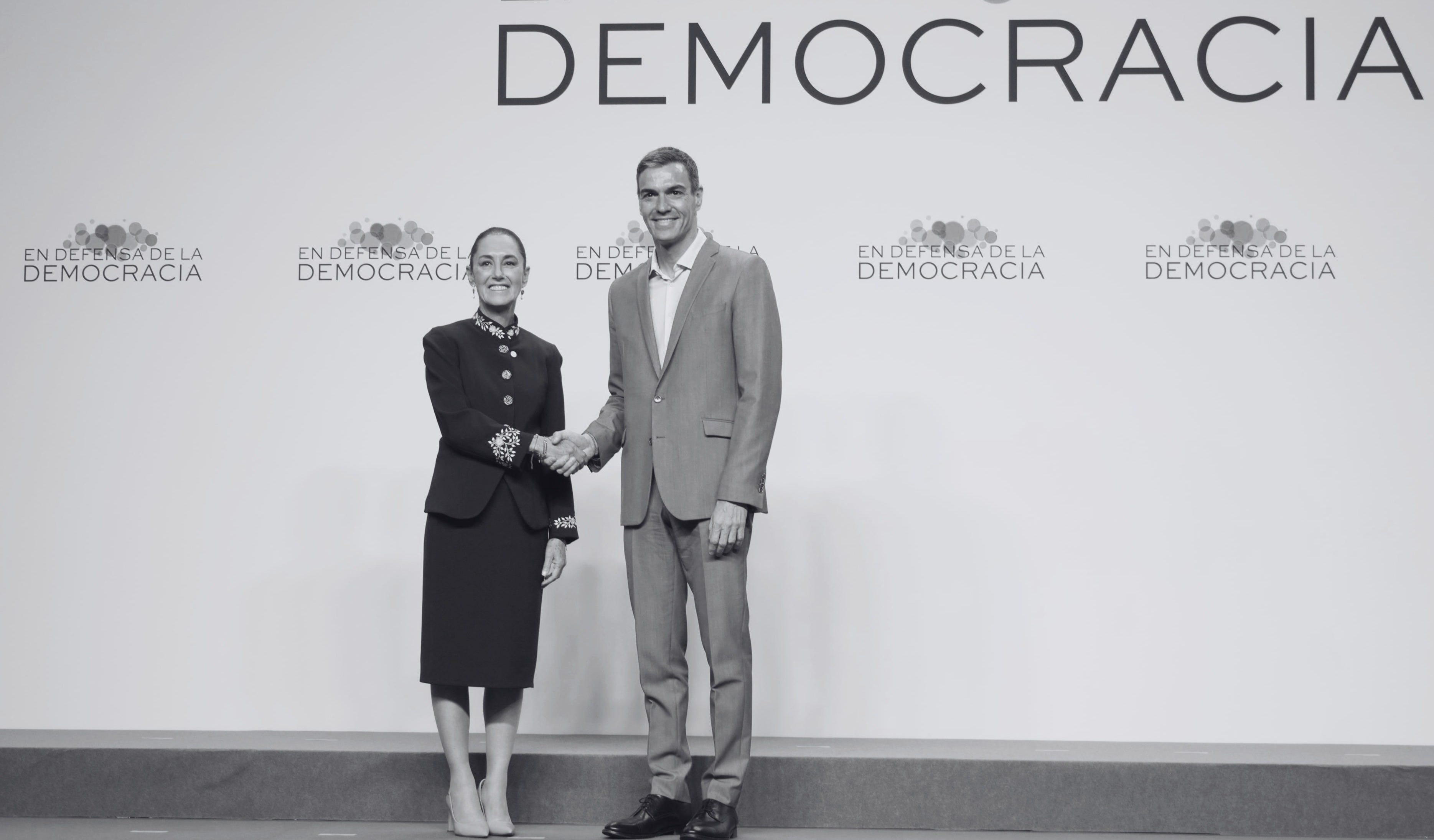
Rancor with Spain: The Mexico-Spain rapprochement had already begun by the end of 2025, but this year has seen the relationship warm substantially, reinforcing not just cultural and economic ties (the second-biggest source of FDI in Mexico), but a political alliance. From Sheinbaum’s well-received appearance at the In Defense of Democracy Summit in Barcelona in April and meeting with Prime Minister Pedro Sánchez (the first high-level bilateral meeting since 2018), to receiving King Felipe VI during the World Cup, it is clear that AMLO’s “diplomatic pause” is over. Claudia has conquered Spain for Mexico. Or at least, for Morena.
There are of course still opponents of the 4T who find solace and affinity with their Spanish political brethren; but when the right-wing President of the Community of Madrid, Isabel Díaz Ayuso, tried to stir up controversy with her visit to “Méjico” in May, her efforts left Sheinbaum unflustered and opposition politicians frustrated.
I’ll be back with next week with some recommended reading and listening. As always, please send me an email at hola@themexpatriate.com or leave a comment below with your questions or feedback.