

The Mexpat Dispatch: March 14
5 environment + tech stories from the national conversation

Welcome to The Mexpatriate.
As the Iran war continues to rock global energy and stock markets, the immediate concerns for most governments are those that hit voters in the wallet: retail fuel prices and inflation. President Sheinbaum announced on March 11 that the government had renewed a voluntary price cap pact with the private sector to keep regular gasoline below 24 pesos per liter; she said lowering the federal IEPS tax to stabilize prices (which would hit the government in the wallet) would only be implemented “if necessary.” The government announced on Friday it would begin subsidizing diesel by reducing the tax, after the Pemex wholesale price of diesel rose 10% last week. Meanwhile, Pemex crude prices rose to US $93 a barrel—but exports have fallen to their lowest levels in 15 years, as government policy has prioritized meeting domestic demand and reducing fuel imports. Mexico still imports about half of its gasoline (almost all of it from the United States).
Inflation crept up in February to 4.02% and March seems unlikely to bring a reprieve as the domino effects of war in the Middle East unfold in other sectors, like agriculture (Mexico imports most of its fertilizer and much of it transits through the Strait of Hormuz). According to Barclays analysts, the inflationary effect of the gas price shocks “should be contained” in Mexico, if the conflict doesn’t drag on too long.
In tonight’s dispatch, I cover five stories about tech and the environment, from oil washing up on beaches of Veracruz and Tabasco to the new government-led effort to reduce online violence against women.
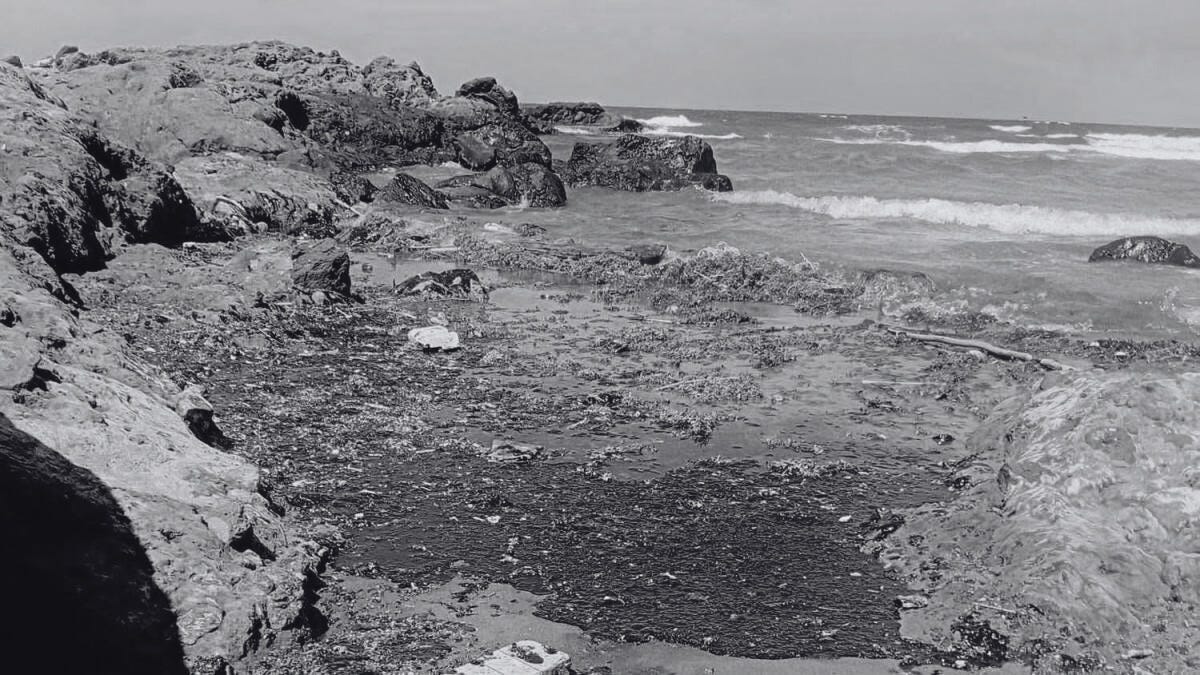
Oil spill, leak or seep?: Nearly two weeks ago, residents of coastal communities in southern Veracruz and northern Tabasco started reporting oil washing up on the beach and damaging their fishing nets. As locals cleaned up the mess, awaiting answers and support from the authorities, the tar spread—affecting 230 kilometers of coastline and the livelihoods of at least 14,000 people in the area who depend on fishing and tourism. Pemex denied there had been any spills from the company’s platforms or tankers, and Veracruz Governor Rocío Nahle (Morena) echoed this, hypothesizing that it could instead be a naturally-occurring seep of crude on Tuesday, March 10. However, by Thursday, Nahle had different information: there had been a spill, but it was from a privately owned oil exploration ship operating in Tabasco, and she said it had been contained. Without naming the company responsible, she took the opportunity to make a political jab, noting it was one that had been awarded contracts during the administration of Enrique Peña Nieto. Federal environmental agencies are now coordinating cleanup efforts with the navy and Pemex, but locals are worried about the damage that’s already been done. One of the contaminated sites is a lagoon that an indigenous community has spent decades restoring in Pajapan, Veracruz: “The collective restoration work by 240 men and women now hangs in the balance.”
Take Back the Night on TikTok?: The president ruffled a few feathers with her decision to celebrate International Women’s Day surrounded by men and women in uniform, leading an event honoring the women of Mexico’s armed forces (42,660 serve in the National Guard, army and air force). But this wasn’t the only item on her women’s rights agenda for the week. On March 11, the administration announced that Google, Meta and TikTok had signed a voluntary agreement with the government to combat digital violence against women and girls. “This is very good for the country, and very good for Mexican women,” she said, highlighting that the initiative will strengthen cooperation between the tech platforms and the government to prevent, detect and respond to online abuse. X was conspicuously, though unsurprisingly, absent—Secretary of Women Citlalli Hernández said they were invited to participate, but declined. Sheinbaum noted she decided not to pursue legal action against Elon Musk for accusing her taking orders from drug cartels in a post on X, and that “communication on these platforms is a major debate…it raises the question of where freedom of expression ends and where attacking a person begins.” According to the government, 18.9 million people were victims of cyber harassment in Mexico in 2024, and 10.6 million were women (2.8 million of them aged 12-19). Meanwhile, Secretary of Education Mario Delgado said Mexico is considering similar age restrictions on social media use as Australia, though he emphasized any policy would need to stem “from the grassroots, from the lived experiences of parents, different communities, and teachers.”
Attack in paradise: Erik Saracho, an environmental activist, journalist and founder of a conservation NGO, Alianza Jaguar, was shot in his home in the beach town of San Pancho, Nayarit early on the morning of March 11. Saracho survived the attack, but remains hospitalized; he had just returned from taking his daughter to the school bus. Saracho has a long history of vocal resistance to developments in the area and had been given government protection as a journalist and human rights defender, including a “panic button” that he activated after he was shot—it took police nearly an hour to arrive at the scene. “We are all afraid for our lives here now,” said his colleague Indira Santos at a gathering of locals the day of the attack. Saracho and his fellow activists had a meeting with the mayor and developers a few days before to address concerns about a new beachside residential complex in the town of 1,500. The environmental group claimed there were irregularities in the development’s permits. Saracho had already suffered consequences for getting into legal battles with developers—his bank accounts were frozen eight years ago and a gag order imposed following his confrontations with the Punta Paraíso condominium development. On Friday night, the state prosecutor’s office released a security camera video showing the attack, and offering a 100,000-peso reward for information about the shooter. During AMLO’s term (2018-2024), at least 123 environmental and human rights defenders were murdered in Mexico, and 14 were killed last year.
Plugging in to El Bajío: Two U.S. companies (Invisible Urban Charging and ATX Smart Mobility) plan to invest US $500 million to install 38 electric vehicle charging stations and deploy 140 electric buses central Mexico, starting in Querétaro and then expanding to CDMX, Puebla and the State of Mexico. While the focus is on infrastructure for commercial fleets, company executives said they see this as part of building a broader charging ecosystem and capitalizing on the growing uptake of electric vehicles (sales of EVs and PHEV rose 38.5% in 2025 in Mexico). “We’re looking at a ratio of 280 cars per charger and the ratio should be 40 cars per charger…so there is a huge opportunity to deploy chargers, not only in Mexico but Latin America globally,” said Eduardo Kuri of Miami-based ATX Smart Mobility.
Money in the seed bank: Mexico is home to one of the world’s most significant agricultural research centers and the largest gene bank for maize and wheat, the Centro Internacional de Mejoramiento de Maíz y Trigo (CIMMYT) in Texcoco. The non-profit emerged from a pilot program to develop higher-yield, resistant crops funded by the Mexican government and the Rockefeller Foundation in the 1940s, led by agronomist Norman Borlaug—who won the Nobel Peace Prize in 1970 for his contributions to global food security. Today, the CIMMYT has 1,300 employees with projects in over 40 countries, but it has been struggling with funding; the dismantling of USAID reduced the center’s budget by US $60 million. However, instead of being left to whither on the vine like other aid beneficiaries, the State Department funneled US $32 million into the center in December, and on Feb. 18, U.S. Ambassador Ronald Johnson announced a US $40 million government award for the center’s research, celebrating bilateral scientific collaboration. But that’s not the only inspiration for U.S. largesse: China, now the world’s largest funder of agricultural research, had shown a bit too much interest in the CIMMYT (the State Department money came from a fund to counter Chinese influence). The center welcomed the U.S. support for research that “[helps] farmers produce more with fewer resources, reduce vulnerability to climate shocks, and reinforce supply chain resilience, contributing to more stable markets both domestically and globally.”
The Mexpat Stat
1,238 wildfires…
…have been recorded by the national forestry service from Jan. 1-March 5, a 30% increase compared to the same period of 2025. The states with the most fires include the State of Mexico, Jalisco, Mexico City, Michoacán and Puebla (the majority are brush fires, only 2% have affected woodland). Peak wildfire season in Mexico is March-May.

Questions or feedback? Send me an email at hola@themexpatriate.com or leave a comment. I’d love to hear from you.